
Pictures Unfolding
What the tactics are showing us going into the knockout stages


When pride and quality collide, the universe responds with a resounding conviction. Tradition, culture, and belief intertwine, creating a sphere that connects us to our roots, the values that run deep within our veins. It’s in those moments — stepping into a stadium packed with strangers, yet feeling as though you’re surrounded by family — that the true joy of AFCON comes alive. There’s something uniquely powerful about it.
No matter where you are in the world, the emotions of this tournament transcend borders, reaching anyone with even the slightest connection to the beautiful game. AFCON is not just a competition; it’s a celebration of African pride, talent, and unity, a stage where stars align and the continent’s collective spirit shines brightest.
As we head into the knockout stages of this prestigious tournament, we take a closer look at the standout tactics that have emerged from the group phase. From low blocks to high pressing, tactical switches to dynamic full-backs — every strategy has played its part in shaping this thrilling spectacle. Prepare yourself for an inside look at the strategies that have defined the first chapter of AFCON 2025.
🚫 Morocco’s Struggles Breaking a Comorian Low Block
Comoros deployed a strict mid-low block with a 5 man defense and 4 man midfield. The aim was to deny penetration into dangerous areas in and around the box. Differences in individual quality between the two teams justify this approach because it is the best way to mitigate the opponents’ strengths — protect the most valuable space and make the pitch as small as possible.
On the other hand, Morocco’s in possession approach seemed a little sub-par for the following reasons:
As is prevalent with most North African sides at club or national level, half spaces are a crucial aspect of their play. For Morocco, Regragui set up an attack that squeezed and extended the opposition by counter movements in wide areas. Having Saibari and Brahim Diaz vacate the flanks to operate as “false 10s” in the half spaces while the fullbacks, Mazraoui and Salah-Eddine, attack the space that opens up. Many times, these triangles between fullback, wide attacker and center midfielder lacked cohesion during positional rotations. The result was that Morocco would find themselves devoid of width and depth in some attacking sequences.
When a team primarily attacks through wide combinations, it is essential to find ways to gain entry into the box. Whether it be by crosses or cutbacks, the ball has to reach viable shooting areas. Considering the approach employed by Comoros, it was challenging to access not only areas viable to shoot in the box but also those that could facilitate entries. Morocco, however, caused their most dire challenge: a lack of quality when executing final actions — especially those aimed at gaining territory in the opponent’s box. For example, they attempted 29 crosses and completed just 5.
And that brings us to one last issue. In a compacted game state where the opponent would rather lose their lives than open up space. Conditions where anticipation, a gene for chaos, and athleticism are required to combine and form a profile of a player that can offer subtle box movements to challenge for duels and snatch any ounce of peace or stability from the defenders, Soufiane Rahimi in the number 9 position was ineffective. He works best with space in front or behind him. Alternatively, one of El Kaabi or En Nesyri would have been a better fit. To be fair, Regragui should have anticipated this because the chances of facing a low block against an underdog are almost 10/10.
🥂 Egypt’s Wide Associative Play
Every time I watch a North African side it’s there, as if to say this is their identity, as if to say this is trained from young age-groups and thus it reflects in the senior national teams. Half-spaces. The Pharaohs used similar tactical ideas as Morocco in wide areas, only theirs were better choreographed. Better timing in rotations, better awareness of each other’s movements, better decisions to isolate or support the ball carrier. The individuals changed; the number of individuals changed. But their shared understanding on how to concur associative combinations in the half spaces prevailed.
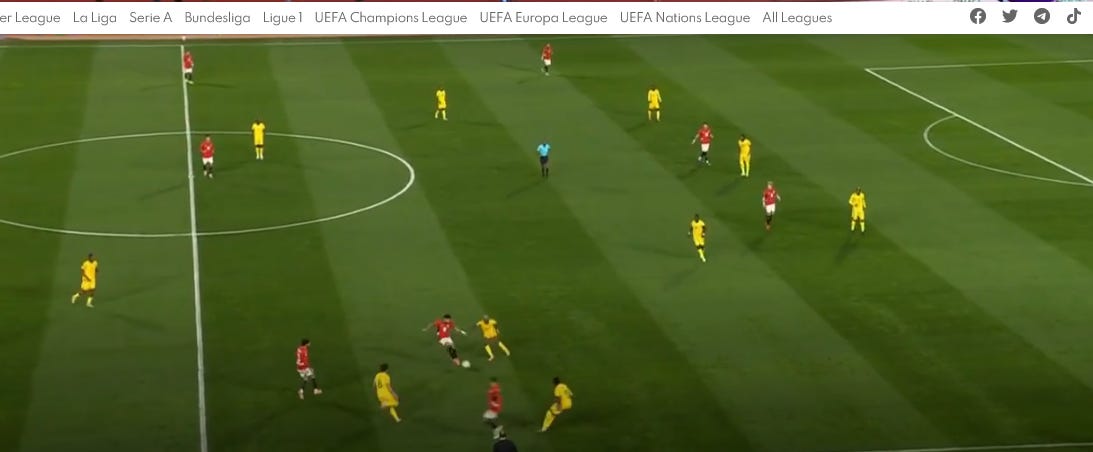
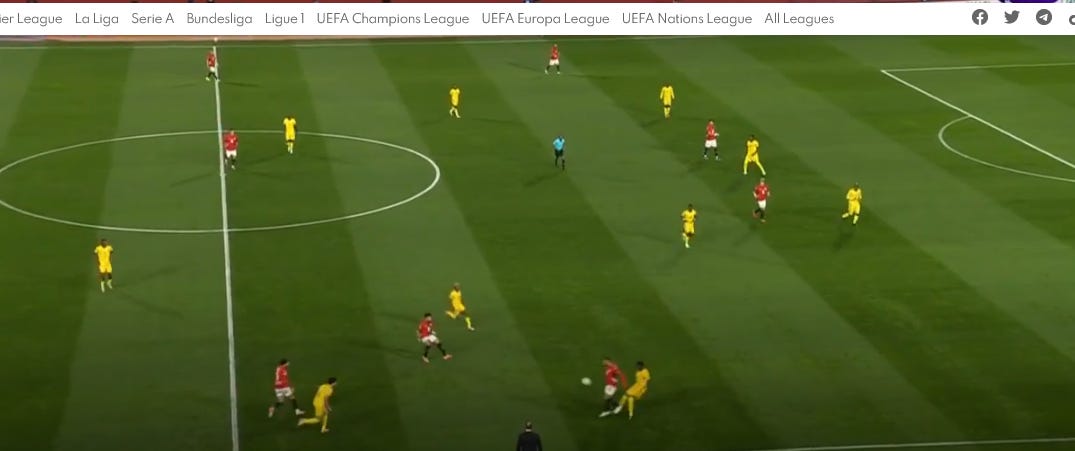
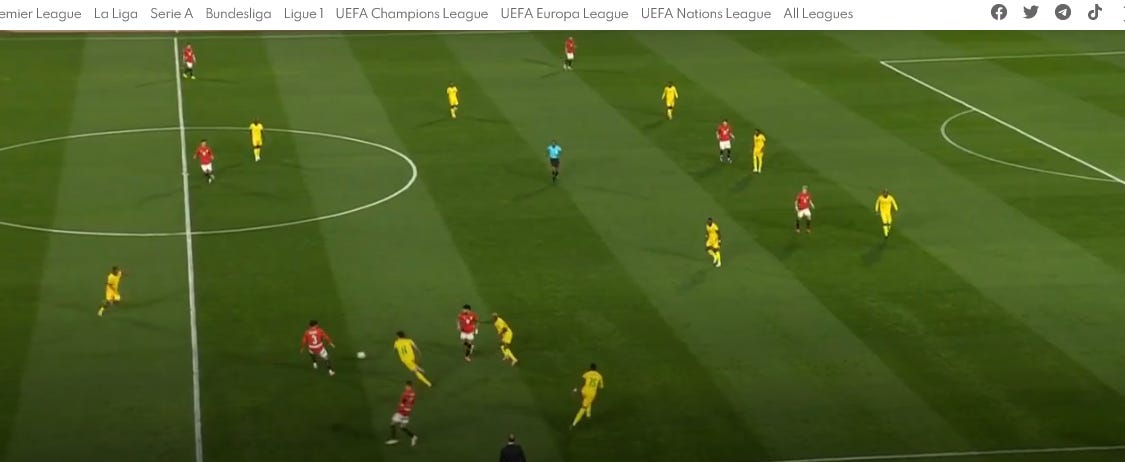
Undoubtedly, the fact that they have been playing together for a long time plays a hand. Another important takeaway is that on-pitch chemistry often mirrors off pitch relationships. When we watch football, we see celebrities and stars, we take them to be instruments playing for our entertainment, but we forget that behind those celebrities are human beings. They have feelings and emotions just as any other person. While we obsess over what happens on the pitch, coaches work to build connections between their players off the pitch. A harmonious environment in which everyone feels valued and cared for shapes how well each individual knows and reacts to others on the pitch.
Tactical analysis is not about defining shapes or formations. It is about recognizing patterns and what enables them to happen, then assessing their efficiency in relation to the opponent. These wide combinations were a recurring pattern throughout Egypt’s tactical approach — enabled by their shared understanding, which has developed over the years and is ignited by social connections off the pitch.
🍚 Nigeria is Witter than Jollof
It is increasingly rare to see a team using a double-striker pair. Most tactical approaches have hinged on having numerical superiority in midfield at the expense of firepower up front, but Eric Chelle said “No!” In a team stacked with quality in the middle, he left players like Ebenezer Akinsanmiro, Raphael Onyedika, Fisayo Dele-Bashiru and Frank Onyeka on the bench in favor of Akor Adams and Victor Osimhen in attack. The upside of having so much quality in a squad is that it allows you to be flexible with regard to the opponent you’re facing.
The system worked in somewhat unconventional ways; there were differences in who occupied width on either side. Against Tanzania, Chukwueze operated almost as a wide attacker on the right side of the diamond midfield, frequently moving between right sided midfield and the right flank. He moved into the right half space and into the pockets between the lines when Osayi-Samuel pushed higher up the pitch. His constant movement inside, outside and beyond the last line, instigated a dilemma in marking duties for Taifa Stars. On the left, Iwobi’s instincts as a midfielder meant Sanusi had to be the primary width holder.
The system edged past a Tanzanian side that, in comparison to the Super Eagles, lacked in quality. But, against stronger opponents, who could match this quality, adjustments would need to be made.
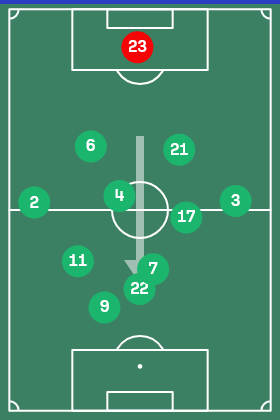
Eric Chelle echoed this sentiment and opted for Onyeka instead of Chukwueze in the match against Tunisia. 10 minutes in, and Onyeka was playing as a proper CM as you’d expect. While this offers an extra defensive man for coverage, it deprives them of an option between the lines, and instead, offers Osayi-Samuel the license to push further up the pitch.
Compare Onyeka’s (8) average position with Chukwueze’s (11) in the earlier image.
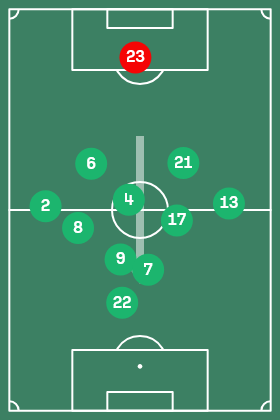
They did well to access the half spaces when Tunisia’s wing backs jumped to Nigeria’s full backs. Upon accessing these spaces, they looked to cross the ball early when possible or find little combinations around the edges of the box.
Early deliveries in the box are Osimhen’s bread and butter, his towering and physically imposing build enabled him 3 shots in the first10 min, 1 by running the channel in a not so good position (low-quality shot), and 2 from crosses at the far post. He had one goal disallowed following an Akor Adams shot that was preceded by a turnover and then a quick run into space.
At 60’ Nigeria bait the Tunisian midfield to press by having Iwobi drop deep and pull out one of Tunisia’s center midfielders while Tunisia’s left winger gets lost between pressing Nigeria’s left back, Bruno, or the left center back, Bassey. Ball is then played into midfield, where Lookman receives in space, and they can attack the last line.
In an age where such a system is a rarity Eric Chelle’s Super Eagles are reminding us of the benefits it offers. And that is being done while getting the best from two of Nigeria’s most in form center forwards.
Side note: Nigeria has scored 2 goals from corners and are one of the few teams I’ve seen taking long throws. Maximizing margins goes a long way, especially in tournament football.
✨ Tanzania vs. Uganda: A Battle of Fine Margins
In this first ever meeting at AFCON, Taifa Stars showed problems in build up as early as 12’. By committing a few players in build-up they chose not to occupy spaces that opened up in deeper areas. Build up orchestrators could not handle the resultant pressure on the ball. They went long way too often.
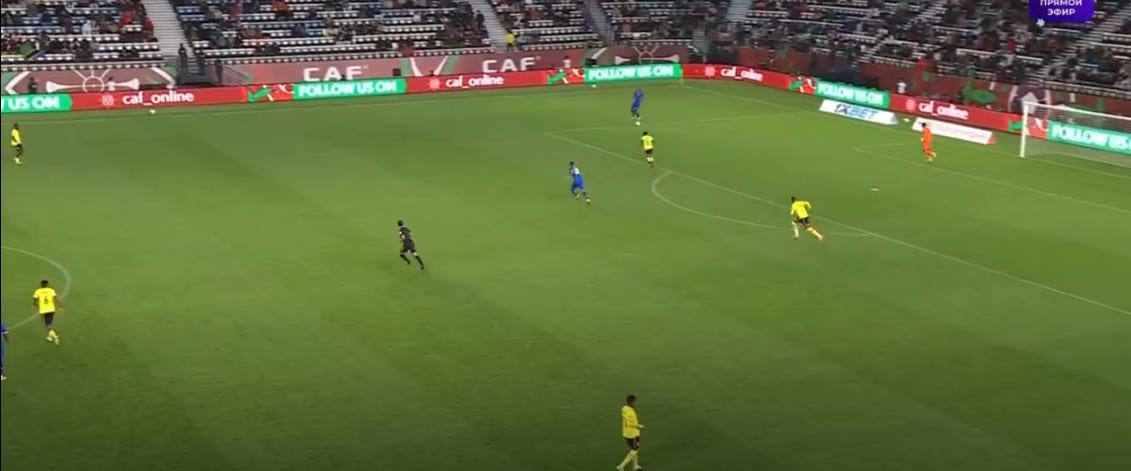
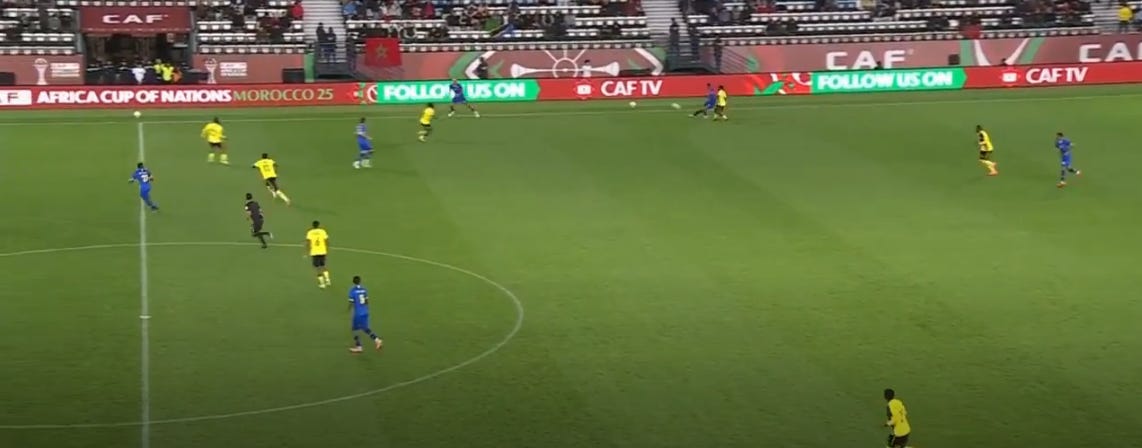
Generally, the Ugandan build up dealt better with circuits in possession. Partly, due to slightly better pressure tolerance rates, but mostly because of the shorter distances they imposed.
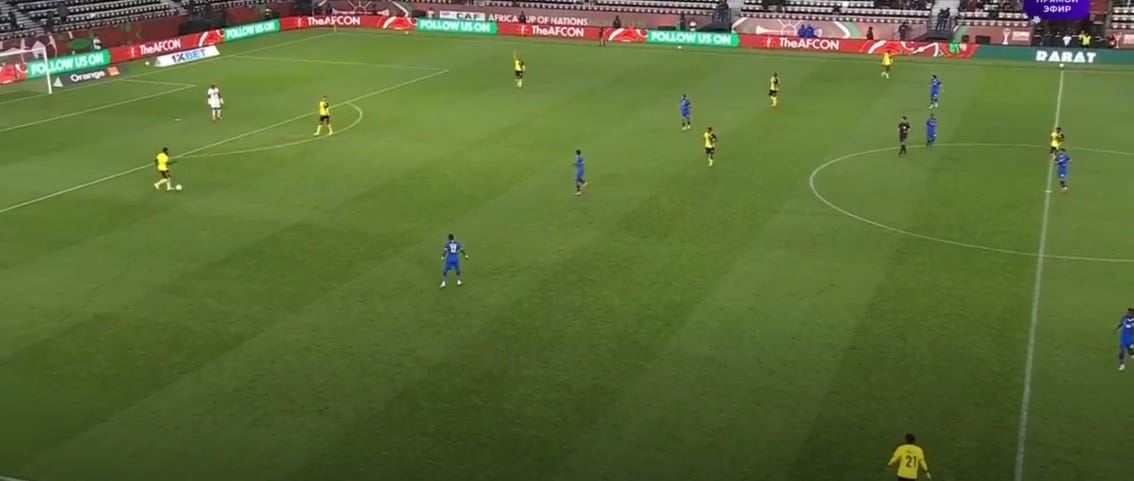
Semakula’s addition in the first line of build up meant that for Tanzania to conduct an effective high press, they had to abandon their zonal setup and switch to a man to man one lest they concede territory or afford Uganda comfortability in the first phase.
This Ugandan setup also allowed Allan Okello to take 2 shots in the first 15 mins. An asymmetrical build up meant the 25 year old winger had the responsibility of holding width on the right flank. By doing this Paul Put was expecting to utilize his passing to find runs (often made by Jude Semugabi), his ability to play in tight spaces when cutting inside, and his shot making in and around the penalty area. As expected the little magician did not disappoint. His curved passes through, around, and behind the defensive line were a constant danger for Tanzania.
It was evident both teams were not applying any breaks going into this match because as Uganda completes a dangerous attack Tanzania counter immediately with one of their own. The potential to be a basketball match was there and it was lived up to.
The game’s end-to-end nature meant there was a lot of running being done and who else to ask for continuous high intensity runs if not Abdul Aziz Kayondo. In this match, where he was used as the primary width holder on the left flank, he was effective in attack via his intense runs on the overlap. His crosses led to valuable box entries. And above all, he left me satisfied that East Africa had produced a repeat intensity athlete.
In football, game states swing, tempo alters, and stakes fluctuate. Simon Msuva’s opener from the penalty spot set in motion a whole new look for the game. Alongside the complexion, strategy changed, and inevitably, the tactics followed. Miguel Gamondi and his technical staff swapped the formation to a 3-5-2 with the addition of Dickson Job. The main takeaway in my eyes was that despite some success against Nigeria, this new system was chosen as a means to even better defensive solidity.
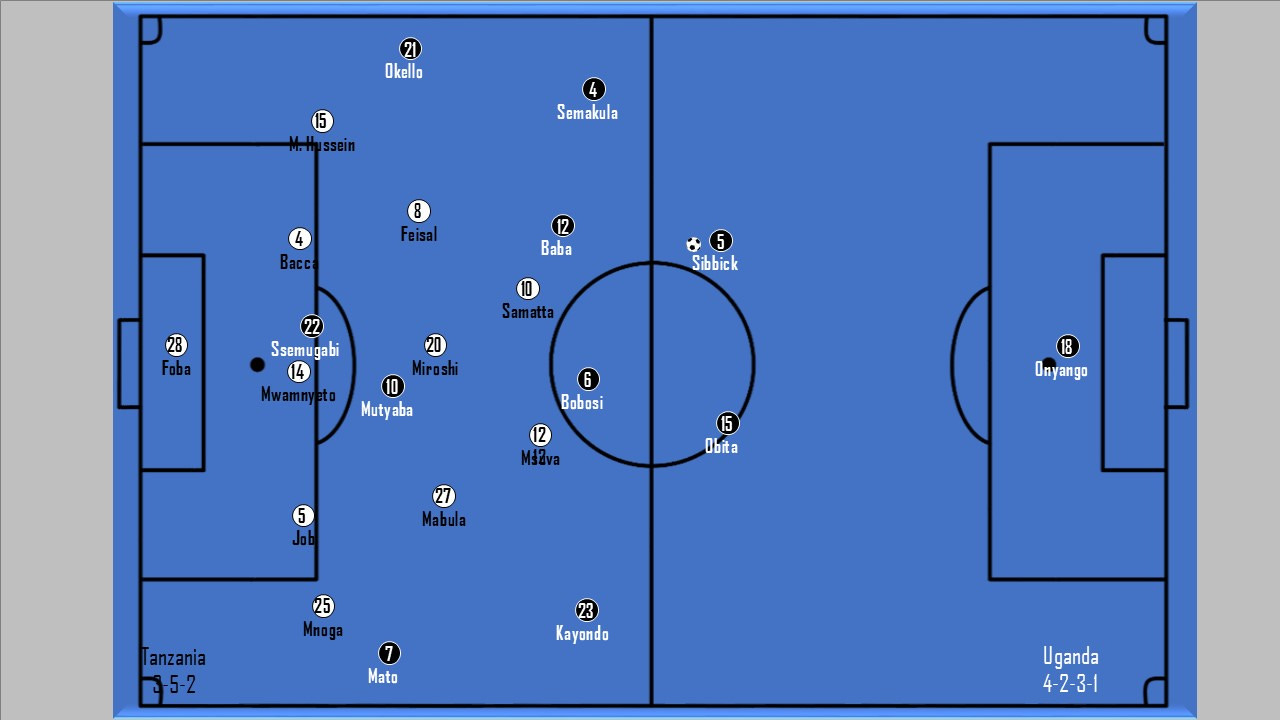
But, there were caveats, 1) Stars had never successfully implemented this setup anywhere, let alone at such a high level tournament and 2) the scarcity of teams using such a setup in the Tanzanian league adds to the players unfamiliarity. Uganda managed to equalise through Uche Ikpeazu who bullied Bakari Mwamnyeto in the box to convert a Rogers Mato cross. The rush of emotions, tempo increasing drastically, while the team chased a winning goal were not conditions favoring smooth integration of a new setup. It was a baptism by fire.
The fruits would be yielded in the next match. Against Tunisia we got to see the 3-5-2 from the start and improvements were vivid. Constant shuffling from side to side constituted a performance that protected central spaces and minimized direct progression down the middle.
👌 A Blockbuster Showdown: Cameroon vs. Ivory Coast
We might have just witnessed the ultimate showdown, oblivious of its nature, deluded by the constant flood of games, we diminish its value, and as a result, miss the nuances. For example, Cameroon’s approach without the ball was one to behold. Differences in pressing approach played a great role in how this game shaped up. While Ivory Coast chose to preserve an extra man in the backline and assign a dual role to one of their center midfielders, Cameroon came with a five man defensive line and tasked the ball side wing back to step out and press Ivory Coast’s full back.
Cameroon’s success stemmed from how well they were able to halt their opponents’ progression, denying them comfortability as well as access to central spaces from deep build up. The Elephants in contrast, had a (theoretically) executable plan: go man to man against the center backs, use the center forward to force play one side, have one of the center midfielders switch between dual markers depending on the ball’s position. However, with the indomitable lions increasing distances between their players in build up, it was practically impossible to cope with switching from marker to marker.
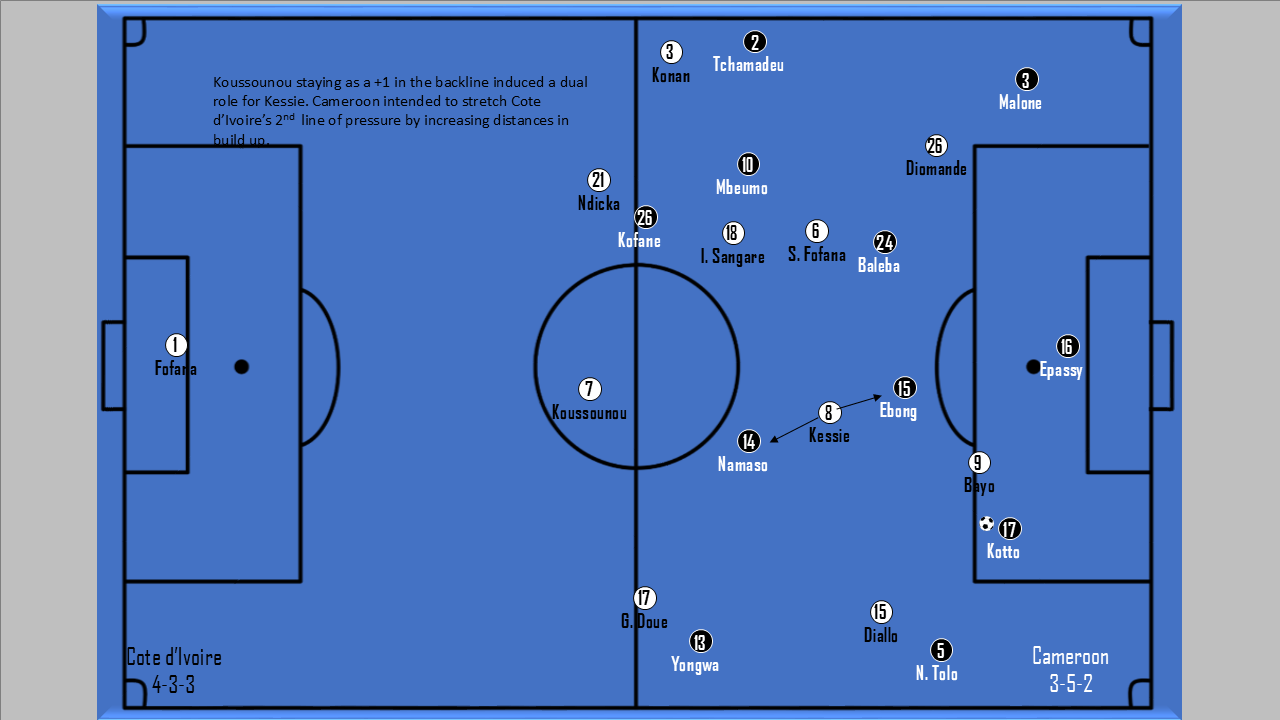
Having a five man backline also afforded shuffling into a 4 man backline when one wing back pressed on the ball side and naturally maintained a one man advantage in the backline. While a plus one advantage proved detrimental to Ivory Coast’s pressing approach and required them to execute near-impossible pressing distances in midfield, it was an advantage David Pagou used to his benefit in one of the best ways possible.
For the Ivorians quality in wide areas was looming. Amad Diallo and Yan Diomande is a wing pairing that would frighten any team in Africa. Rightly so, because Amad scored the opener for The Elelephants. But their success with the ball depended on how they dealt with two things, which on that night, they quite miserably failed (at least for 45 minutes). The first, Cameroon’s high block/press. The second, their own high block/press.
Captaining the Cameroonian side was Nouhou Tolo, leading by actions Nouhou acted as the auxiliary center back. In other words, he was a combination of a wide center back and a left back. Through his movements the team oscillated from a back-four to a back-three which was a crucial part of their build up.
Questions remain on Cameroon’s development being timely and in tandem with the tournament. In particular, their build up was one that is atypical of a team that goes all the way. Too often they went long quite easily when pressed and based their game on aerial and second balls. There is still a considerable gap in level between their in possession and out of possession approach. It is true that most teams they’ll encounter in the knockout stages are not accustomed to the ‘kick and rush’ game they play which might play into their advantage, but such an advantage does come with its perks, specifically, increased variance and unpredictability.
❌ Mid Blocking With Triangles in Possession
Talking of the out of possession part of the game, Mali gave us another spectacle, though theirs was different from Cameroon’s in that they employed a different setup and had different goals to achieve.
Tactics are not about how shapes are tweaked or how games change in between. They are a means to achieve specific goals that increase the probability of winning football matches. Tactics start from the discussions amongst the technical staff: brainstorming ideas and assessing their tools and viability to execute, then, choosing the most optimal one. That is why there can be various ways to achieve the same goals. Differences in goals to achieve call for different tactical strategies.
Considering Morocco’s quality, it was a good idea to try and minimize their effect on influential areas of the pitch. This was done in two ways:
A mid block: in contrast with The Indomitable Lions’ approach that involved applying pressure on the opponent in build up, Les Aigles sought to sit off and protect space in the middle third of the pitch via a compact 4-4-2 block.
Personnel: Lassana Coulibaly, Aliou Dieng, Mamamdou Sangare, and Mahamadou Doumbia — all four primarily central midfielders — started the game. It seemed Tom Saintfiet was not content with only having a structure that attunes to his game plan, he wanted to reduce (maybe even eliminate) any sort of unpredictability. Having these four, plus Yves Bissouma — another central midfielder — in front of them offered a degree of central protection higher than the norm. This approach, coupled with a solid structure, made it harder for the Atlas Lions’ to penetrate and forced them to settle for a 1-1 draw.
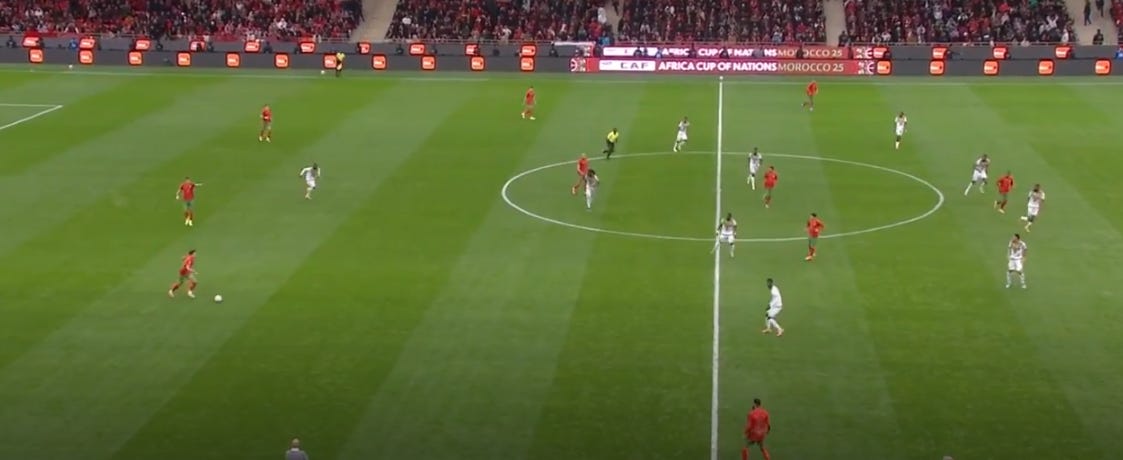
In the image above you can clearly see how Mali lined up in two compact banks of four preceded by a bank of two (Lassine Sinayoko is making his way back into position). The aim was clear, as seen here, there was little to no pressure applied on the Moroccan center backs throughout the game, instead there was immense pressure applied in the middle third. The key was distancing. As long as they were close they could control which spaces their opponent had access to.
Things got even juicier in possession. Full backs could bomb forward when the need arose knowing their midfielders would provide temporary coverage in transitions. Also, having a great number of midfielders aided Mali’s possession as each one of them had the ability to receive, keep and pass the ball to a teammate very well.
🚀 Let Flyers Fly
In three group stage matches Senegal’s full back pairing, Krepin Diatta and Ismail Jakobs, have attempted 17 and 16 crosses according to FBref. An average of 5 crosses per match. That reflects exactly what our eyes have been seeing: the two of them constantly sprinting up and down either flank. If you have watched Senegal play in this AFCON, I’m sure you’d agree that their full backs have been a crucial piece in how they attack.
Pape Thiaw has reinforced Aliou Cisse’s profiling and utilization of wide attackers and full backs in possession. It’s a pretty old trick that works every time you do it accurately. Simply, have your wingers tuck inside and let the full backs arrive dynamically into those vacated spaces for crosses. You could argue that this is predictable, but they vary it. Here’s an example.
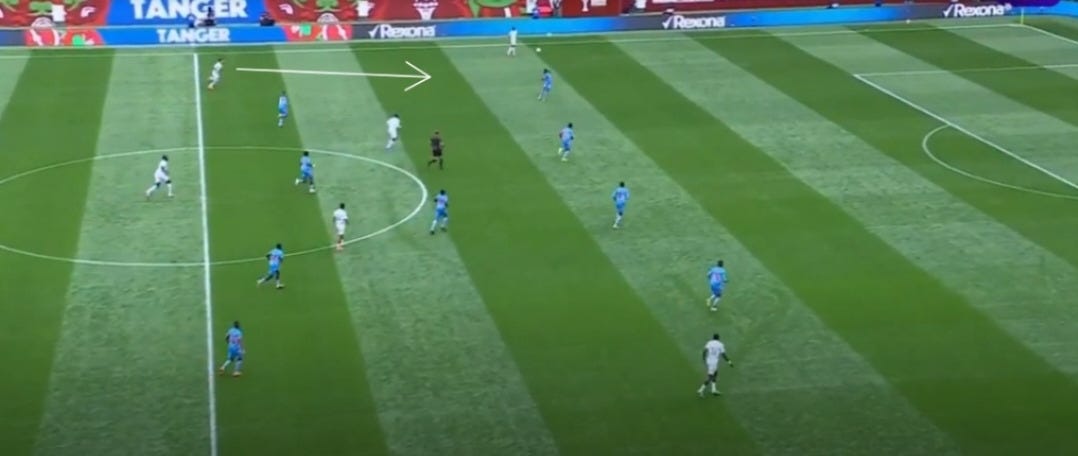
As the ball is in the air from a long diagonal pass, Sadio Mane has peeled off from the tenacious Aaron Wan Bissaka to give himself extra time and space. Just as Wan Bissaka turns to look at Mane, Ismail Jakobs starts his marauding run through the left half space, he attacks the Congolese right back’s blindside with just enough stealth to stay undetected. He gets on the end of the cross, but unfortunately, Theo Bongonda is awake and spots the run before blocking the ball for a corner.
The two Senegalese full backs embody the concept of flyers as coined by Jake Entwistle from SCOUTED.
“The first Full-Back Archetype will be the most familiar. The Flyer is characterized by the lung-busting runs and the relentless whipping of crosses synonymous with the traditional role.”
And so far, the flyers have been flying.
On the other hand, it has not been as easy for Thiaw to profile Senegal’s attacking options. Three of their best attackers in Sadio Mane, Illiman Ndiaye, and Ismaila Sarr are all more or less wide players who thrive on 1v1s, runs in behind, cutting inside to central areas, and arriving into shooting positions to finish chances. Mane has been previously used in the number ten spot when he was at the peak of his powers, but given his current form, it’s questionable whether he could fulfill the requirements of the role.
In the end, Thiaw opted for Illiman Ndiaye as the man behind Nico Jackson. And we are here to say it was a good decision.
Not only is he nimble, wriggly, and tidy in small spaces, he is also a potent ball striker and combines well with teammates. His unique type of athleticism that constitutes fluid biomechanics coupled with great brain body coordination allow him to perceive situations quickly and formulate solutions. All that said, he still hasn’t reached the level of output you’d expect from a number ten, as the tournament unfolds he will probably grow into the role and increase his output rate.
😎 Bafana Ba Style
Aesthetics can be disliked in tactical discourse, and for good reasons. What matters is how effective you can be when executing actions, not how good you look doing so. But when a balance is struck between the two, the best style of football emerges. Bafana Bafana has always embodied this.
Anyway, that is not why they are in this piece.
Unfortunately, they are in this piece so we can discuss a tactical battle that Hugo Broos was losing until saved by Mohammed Hany’s red card. South Africa lined up with three center midfielders — Thalente Mbata, Teboho Mokoena, and Siphephelo Sithole — in their 4-2-3-1 formation. Mbata, the youngest of the three, played behind center forward Lyle Foster in a three-man line that was completed by Oswin Apollis and Tshepang Moremi.
It has been a longstanding problem at international level in African football for teams to lack central creative players, it is no different for Bafana Bafana. Their options in the squad immediately indicate a reliance in wide players for creativity, something that was not seen in the first half against Egypt for two main reasons:
Both Moremi and Apollis started the game on their strong footed sides (right footer on the right, left footer on the left). Most times I have seen coaches employ this, and afterwards questioned about it, they answered it was for quick deliveries into the box. For Bafana Bafana that also meant sacrificing the 1v1 quality they had in wide areas because neither of the two wingers were comfortable dribbling from these angles. Consequently, the expected threat from quick deliveries was nullified by point number two.
Egypt’s out of possession approach limiting progression. To deliver the ball into the box, the South African wingers had to first get in positions where this was possible, the Pharaohs made sure this was a very hard task.
Though somewhat unconventional, here is how they did it.
Mohammed Hany at right back occupied a high starting position so that whenever the ball went to the left sided center back, Mbokazi, Hany jumped out to press the left back, while Salah followed and pressed the center back. Then, a series of shuffling movements were triggered: Yassir Mohammed covered the space vacated by Hany, one of the two center midfielders dropped into the back line, and Trezeguet squeezed centrally as an extra midfielder. It was common to see an ocassional last line of 5 for Egypt despite shaping up with a back four on paper. Their center midfielders, mostly Hamdy Fathy — who later went on to play as a center back — dropped in and out of the last line continuously.
This tactic allowed Hossam Hassan’s side to maintain pressure on the ball in the middle third of the pitch by going man to man on the ball side area. The downside was that there was always a free player for South Africa in possession, but the Egyptians were content with letting this happen because the free player was in the ball far area, and due to the zonal nature of their block in the center and on the far side, it was hard (almost impossible) to access that player when they had locked in on the ball side.
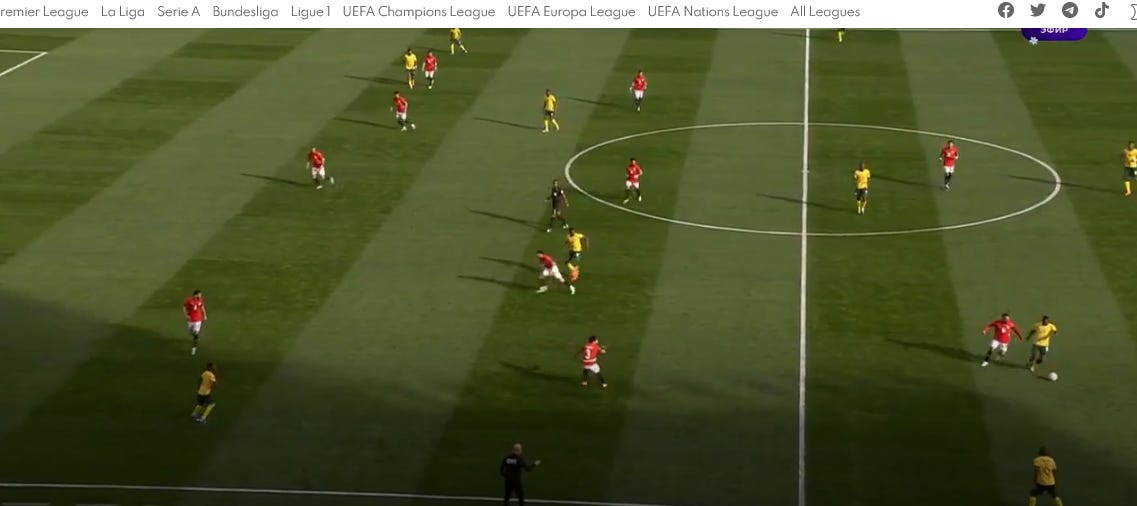
A couple times (including this one) Hany looked confused by his duties. You can see him here trying to retreat into his natural position when the pressing instance was not over.
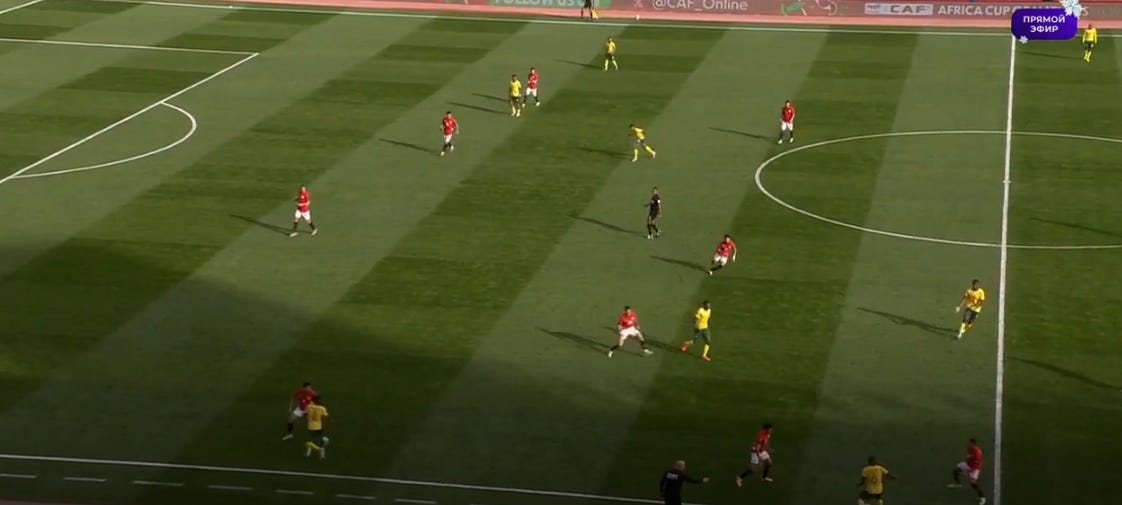
He finds his way back but by now he is late, Salah had already been forced to press Modiba and leave Mbokazi free. At the same time, when Mokoena shows up for the ball one of Attia or Marmoush should be tracking him. Marmoush is unbothered, Attia second guesses and only steps up after checking to see if there’s cover behind.
This gives Mokoena an extra second to receive. The press is broken, Bafana Bafana find their way to the other side and start another attacking sequence.
Ideally, you’d want to conjure a structure so confident no one has to worry about being covered. It gets harder to do this at international level where time is much less in between matches. Inconsistencies were evident.
These shuffling movements kept recurring for the entirety of the first half until (yes, you guessed it) Mohamed Hany’s red card. While they dominated the ball with 52.2% possession in the first half, Mandela’s grand kids failed to progress or create scoring chances. Play swept side to side and possession remained retentive. One shot and only eleven passes into the final third in the first half. It’s interesting to think what would have happened had Egypt not gone a man down.
💊Bottom line
From the diversity in shapes, the contrasting ideas, and multiple methods to execute strategies to the technical mastery, competitive ambition, and fulfilled expectations, it has been fun. An interesting competition by every standard. It’s even more exciting that it has only begun.
The giants have lived up to their names, nonetheless, the underdogs have not made it easy. As the tactical landscape continues to shift, the line between prestige and performance is blurring. We aren’t just watching a clash of teams, but a collision of philosophies and in this high-stakes chess match, the next move promises to be the most daring yet.